How PT Helps
A Physical Therapist assesses each patient’s needs based on a medical history and physical exam. Treatment programs are customized to assist each patient in returning to their pre-injury function and resuming normal activities without pain.
Education: Many hand and wrist problems can be prevented through proper posture instruction and ergonomic occupational techniques.
Manual massage: The Physical Therapist will use massage to improve blood flow, desensitize irritated nerves, and aid in the breakdown of scar tissue.
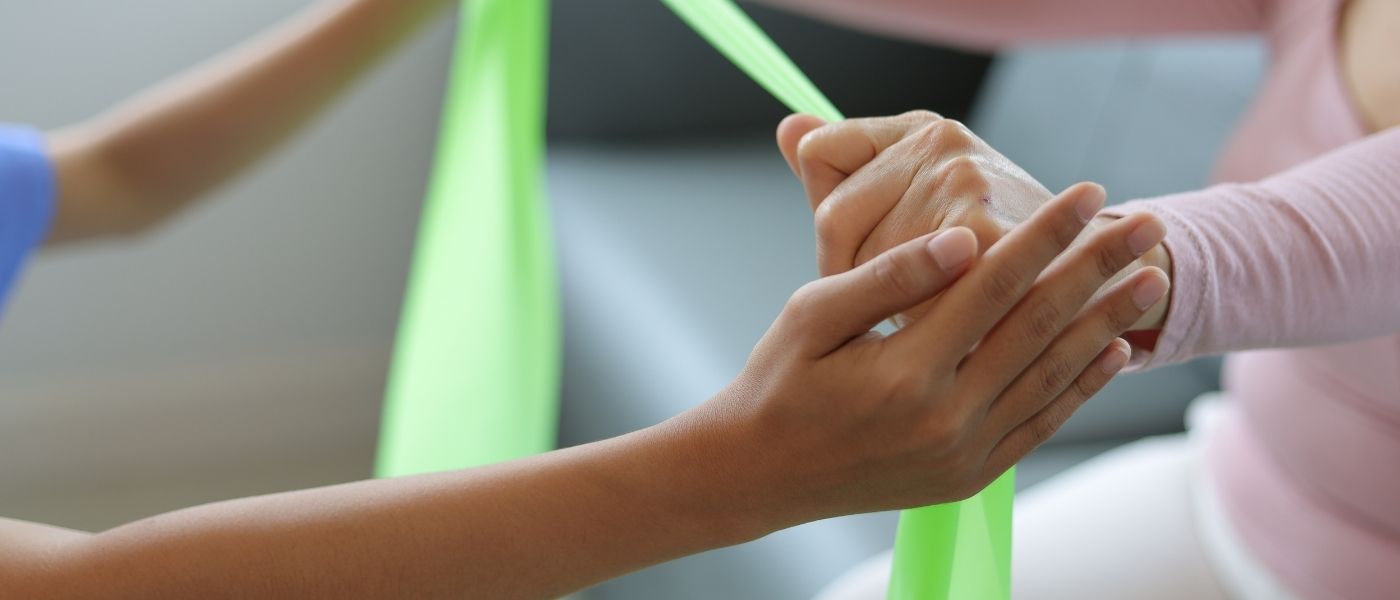
Passive range of motion (PROM): The Physical Therapist will manually assist patients with PROM by flexing and extending the affected joint. (Passive manual assistance means the therapist, not the patient, moves the joint.) This helps discourage fluid buildup and maintain ROM when the forearm muscles are not supposed to be activated. PROM is also helpful when movement is too painful, and the patient needs to be encouraged to maintain ROM.
Active range of motion (AROM): The opposite of passive ROM, in which the patient actively moves the joint themselves using specific muscle groups. The Physical Therapist will encourage AROM by providing exercises that strengthen the muscles of the upper arm and forearm and help in flexion (bending) and extension (straightening) of the elbow, wrist, and fingers. AROM is an important progression following injury or surgery to regain function.
Nerve glides: These gentle stretching and movement techniques focus on compressed or irritated nerves to improve pain, ROM, and function.
Splinting: The Physical Therapist may place hard casts or craft custom orthotic bracing for support or protection; they may also recommend an over-the-counter brace or splint.
Compression: Compression sleeves help to improve and prevent edema (swelling). They can also help with pain that responds well to pressure.
Strengthening: Strengthening the arm and hand muscles can improve joint stability, load distribution, posture/alignment, and ROM. The muscles that support joints between the elbow and fingers are:
- Extrinsic muscles of the hand and wrist: These muscles originate in the forearm and help with basic movements, such as gripping, flexion, extension, and fine motor control.
- Intrinsic muscles of the hand and wrist: These muscles are located within the hand and wrist, and aid in pinching, grip strength, and precise finger movements required for fine motor tasks.
- The muscles that support the function of the elbow are:
- Flexor digitorum superficialis, flexor carpi ulnaris, flexor carpi radialis, and pronator teres: Maintain valgus stability (elbow resists outward bending forces) and alignment of the elbow.
- Extensor digitorum communis, extensor carpi radialis brevis and longus, anconeus, and extensor carpi ulnaris: Maintain varus stability (elbow resists inward bending forces) and alignment of the elbow.
- Biceps brachii: Helps with elbow supination (where the palm faces up/out and flexion.
- Brachioradialis and brachialis: Elbow flexion.
- Triceps brachii and anconeus: Elbow extension.
Other treatment recommendations may include activity modification, heat and/or ice, nerve stimulators (TENS unit), or topical pain relievers.
Limited movement and pain in the hands, wrists, and elbows can make everyday tasks frustrating or impossible. By targeting the specific muscles, tendons, and joints involved, PT helps restore function, reduce pain, rebuild confidence in coordination, and get you back to the activities you enjoy.