How PT Helps
A Physical Therapist assesses each patient’s needs based on a medical history and physical exam. Treatment programs are customized to assist each patient in returning to their pre-injury function or resuming normal activities without pain.
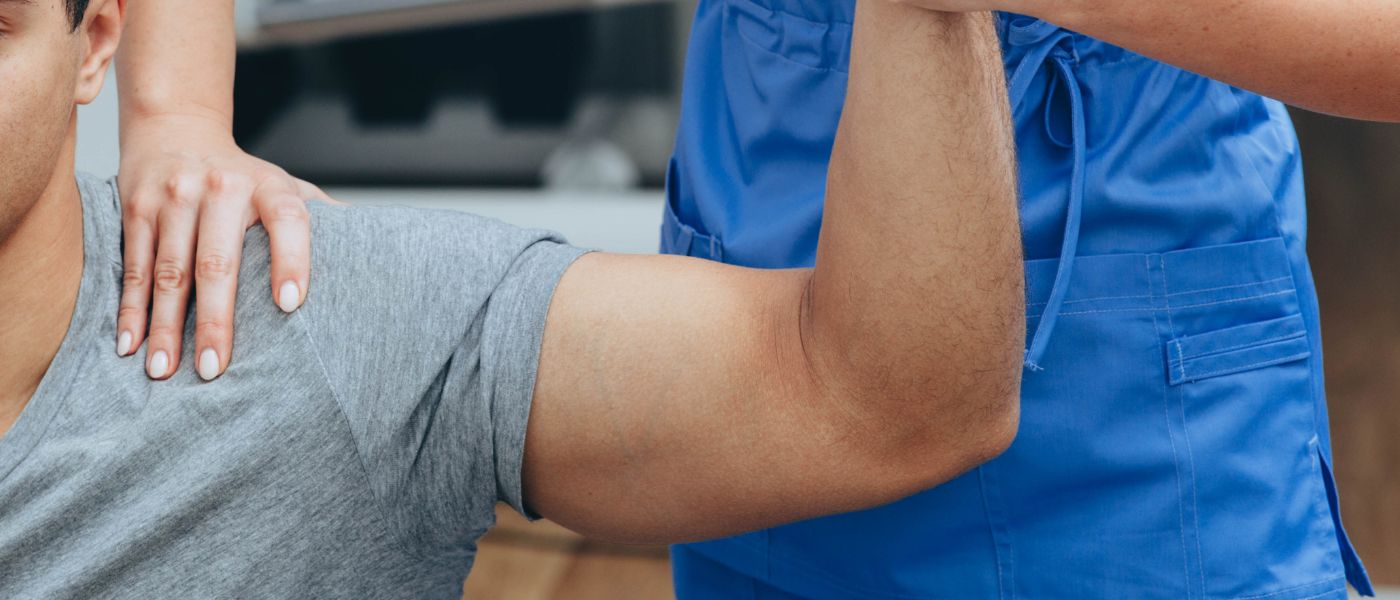
Passive range-of-motion (PROM): PROM exercises maintain shoulder rotation and movement without activating the surrounding muscles; the therapist, not the patient, moves the joint. These exercises are best done after surgery, fracture healing, or when pain makes it difficult to move the shoulder.
Active range-of-motion (AROM): The Physical Therapist will encourage AROM, in which patients actively use their shoulder muscles to move the upper arm, at the appropriate stage of recovery. Exercises focus on the shoulder’s supporting muscles to move the upper arm to improve flexibility, regain function, stabilize the joint, and prevent further injury to the shoulder capsule and associated structures.
Strengthening: Elastic bands provide resistance to help maintain and rebuild the muscles that support the shoulder. Bands come in varying levels of tension, and as the shoulder muscles recover and gain strength, the Physical Therapist may increase the resistance to encourage further muscle development and stability. Several upper back and shoulder muscle groups help the upper arm and shoulder function:
- Rotator cuff: These four muscles provide primary support for the shoulder (glenohumeral joint) and keep the humeral head in place.
- Supraspinatus: Abduction (initiates movement away from the body) and stabilizes the shoulder.
- Infraspinatus: External rotation.
- Teres minor: External rotation and some adduction (movement toward the body).
- Subscapularis: Internal rotation and some adduction.
- Rhomboid minor/major with levator scapulae: Retract and elevate the scapula; levator scapulae primarily elevates the scapula.
- Pectoralis major: Adduction and medial rotation of the arm.
- Pectoralis minor: Depresses and protracts the scapula; pulls it downward and forward.
- Deltoids: This muscle is composed of three distinct parts, each with specific actions:
- Anterior (front) fibers: Flex and internally rotate the arm.
- Middle (lateral) fibers: Abduct the arm (lift it away from the body).
- Posterior (rear) fibers: Extend and externally rotate the arm.
- Trapezius: Elevates, retracts, and depresses the scapula; also rotates it upward.
- Serratus anterior: Extending the scapula (like when punching something); also lifts the ribs to aid respiration.
- Biceps brachii: Flexes the elbow, supinates the forearm (rotates the palm upward), and assists with shoulder flexion (lifting the arm forward).
- Triceps: Extends the elbow (straighten).
Other treatment recommendations may include activity modification and the use of heat and/or ice.
Physical therapy works as an adjunct to physician- and surgeon-directed care to help patients reclaim daily function. Through targeted exercises, guided movement, and gradual strengthening, PT supports shoulder healing, reduces pain, and restores mobility.